
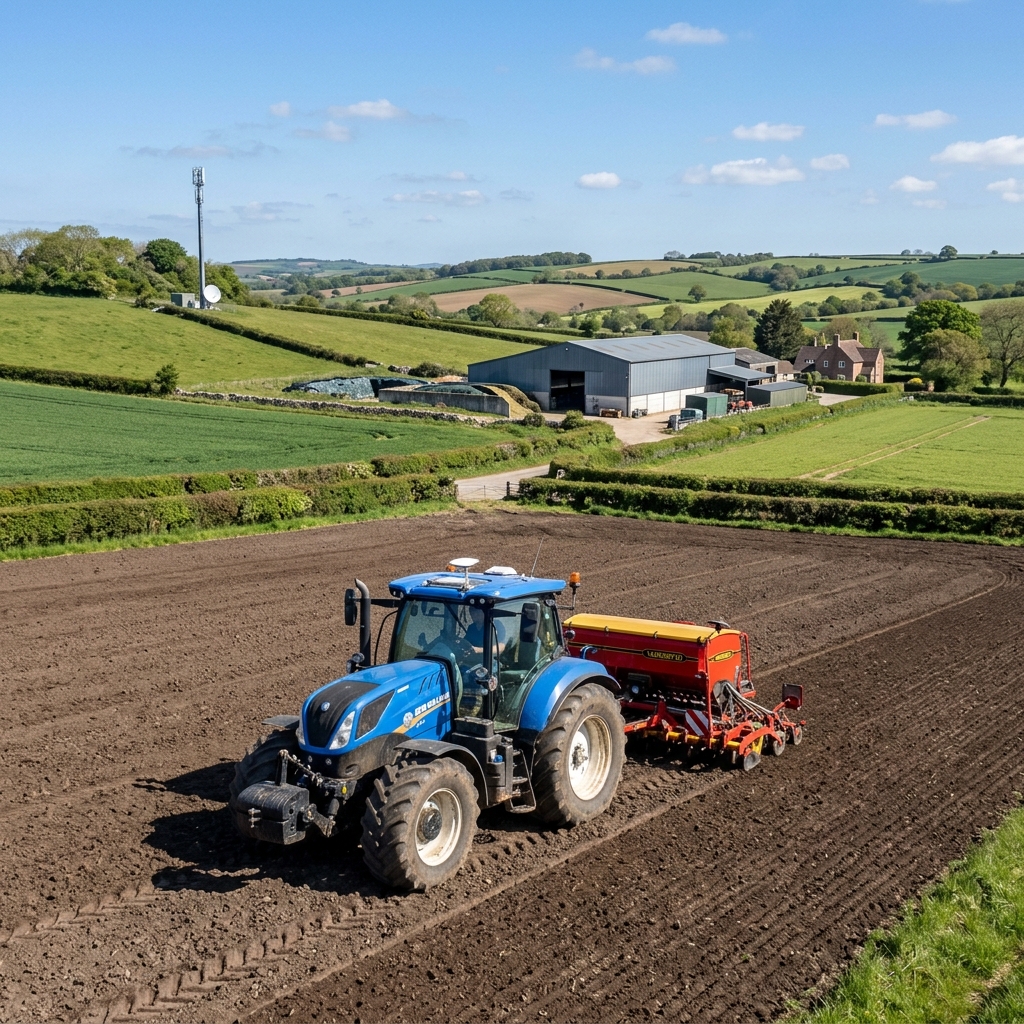
Agricultural Mobile Connectivity: How Anywhere SIM Keeps Farms Online
From GPS-guided tractors to remote livestock trackers, discover how a multi-network SIM for agriculture keeps every corner of your farm connected—no matter the terrain.
British farms are becoming data businesses. Yield mapping, automated feeding, remote sensors, and livestock trackers all quietly depend on one thing: reliable mobile connectivity for farms. Yet ask any farmer where their coverage is weakest, and they’ll usually point somewhere—the lower field behind the hill, the far end of the yard, the polytunnel with the metal frame. How can Anywhere SIM be used in agricultural settings to close these gaps? By giving every device on the farm access to any supported network where signal is available, rather than locking it to just one.
Why Farms Are Hard to Keep Connected
Unlike an office or a shop, a farm isn’t one fixed location-it’s a sprawling, irregular patch of land with its own microclimate of signal problems. This is one reason rural areas have poor mobile coverage in the first place.
- Varied terrain: A single field can span a hilltop with strong signal and a dip or valley with almost none.
- Distance from masts: Rural land is, by definition, further from the infrastructure that urban areas take for granted.
- A single network’s blind spots: The network with the best signal at the farmhouse isn’t always the one with coverage at the far gate or the bottom paddock.
A standard single network SIM locked to one network will only ever be as reliable as that network’s coverage in that exact spot. On a farm, that’s rarely good enough!
The Solution: Unsteered Multi-Network Connectivity
To overcome these challenges, a multi-network approach is essential. By utilizing a SIM card that can roam across multiple networks (O2, Vodafone, Three, and EE in the UK), your farm equipment can dynamically connect to whichever network offers the strongest signal in its current location.
This means you are no longer tied to the coverage map of a single provider. If the tractor moves behind a hill and loses its primary connection, the SIM automatically switches to an available alternative, ensuring continuous connectivity for crucial farming operations.
For specific examples of how this technology is applied in daily farming tasks, check out our follow-up article on the Everyday Agricultural Uses for a Multi-Network SIM.